Sunday, February 28, 2010

Ever Has It Been


Grief is a strange entity for its unpredictability, its tugging, its palpability, its pinpoint. Everyone has felt grief, and everyone has felt joy, but grief is defensible. No one lays claim to other emotions the same way; few are able to admit-especially in the onset of its clutches- that any other has felt this grief. It’s the only emotion where context truly matters, where the grieving can grip their pain with the surety that none other has ever felt the exact same style of grief.
Grief is tailored to us, a worn grey dress. We all own it, we all have worn it, we all pray it stays folded at the bottom of the drawer; and though they’re all of the same cloth, each is cut a little differently. We’ve each embroidered it in our own way.

Grief is fleeting. Not in that it disappears quickly, for even a moment of grief feels like an eternity; but in how it comes and goes. A smell, a memory, a sharp crash- and everything comes flooding back. Grief is an active emotion- it must be remembered to have an impact. The few moments after waking up carry the most bliss for the grieving, for in those groggy seconds, the reasons for a heavy heart aren’t quite to the forefront of the mind.


“

“My heart’s broken,” he thought. “If I feel this way my heart must be broken.”
After a while he heard his father blow out the lamp and go into his own room. He heard a wind come up in the trees outside and felt it come in cool through the trees outside and felt it come in cool through the screen. He lay for a long time with his face in the pillow, and after a while he forgot to think about Prudence and finally he went to sleep. When he awoke in the night he heard the wind in the hemlock trees outside the cottage and the waves of the lake coming in on the shore, and he went back to sleep. In the mornings there was a big wind blowing and the waves were running high up on the beach and he was awake a long time before he remembered that his heart was broken.


”

Ernest Hemingway
Ten Indians


The hearts of my Church, of my family community there, my brothers and sisters, pour out today for the loss of a woman: a mother, a wife, a friend. Her daughter is an integral part of our ministry. So we grieve, they grieve, those closest to the family cry, we all hold our living parents a little closer to our hearts. We all pray for grace like a blanket to cover up that grey. We all know Grief, we know her intimately, and she knows us.

Unique and yet unifying.

So grief is sorrow, it’s bitter, and we never wish for it. When it’s folded softly away, we forget its existence. But as lamentable as the causes of grief, shouldn’t we, as mortal beings, be glad for her at some level?


The loss of something means it once existed, and meant something- and the things that mean something change us and mold us into who we are. Pocahontas, the Disney version, speaks to that:


Pocahontas: It would've been better if we never met. None of this would've happened.
John Smith: Pocahontas, look at me. I'd rather die tomorrow than live a hundred years without knowing you.
Pocahontas: I can't leave you.
John Smith: You never will. No matter what happens to me, I'll always be with you, forever.


We hold onto that, as grievers. The idea that those lost are forever with us- even if not in a physical sense.


And somehow, with time, it becomes almost enough.

Wednesday, February 17, 2010

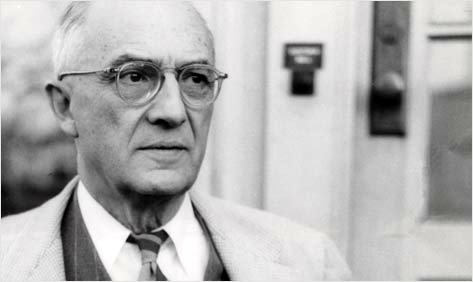
William Carlos Williams


William Carlos Williams helped foster the transition to modern poetry, with a focus on the everyday: on ordinary events, things, people, places, and emotions. Known as a liberator for his imagist poems, Williams’ poetry oftentimes focused on a single object or image so intently that it ceases to be seen as anything less than poetry. This idea can best be portrayed through “The Red Wheelbarrow”, but is also seen in “Danse Russe”, and “The Widow’s Lament in Springtime”.


The Red Wheelbarrow

so much depends
upon
a red wheel
barrow
glazed with rain
water
beside the white
chickens.


A wheelbarrow is one of the simplest and most useful elements of a farm, and yet Williams places such exclusive attention on it that the broken sentence is rendered poetic. The deep focus pushes the reader to discover that “the wheelbarrow is not an ordinary object, but is the poem itself” (CCCCD). Williams seems to paint the poem, utilizing line and color to vividly depict the scene: the white of the chickens contrasts the red of the wheelbarrow, which is glazed with water as if a piece of pottery. Just as Williams offers a fresh perspective on a vital tool, rain is used here, as in much of literature, to freshen or make new the image of the wheelbarrow within the poem.
The diction of the poem mirrors its content; as much depends on each word for the function of the poem as on the wheelbarrow for the function of the farm. The stanza breaks and commitment to the image allows a single sentence to become poetry.
Though the wheelbarrow is undoubtedly important, the reader is left to discover why on their own; the wheelbarrow simply sits besides the white chickens, unaware of the stir its rarely applauded significance is causing.


Danse Russe

If I when my wife is sleeping
and the baby and Kathleen
are sleeping
and the sun is a flame-white disc
in silken mists
above shining trees,--
if I in my north room
dance naked, grotesquely
before my mirror
waving my shirt round my head
and singing softly to myself:
“I am lonely, lonely.
I was born to be lonely,
I am best so!”
If I admire my arms, my face,
my shoulders, flanks, buttocks
again the yellow drawn shades,--

Who shall say I am not
the happy genius of my household?


Every person craves a strange or wild freedom that exists solely, or at least best, when alone and out of sight of societal censure; a werewolf-esque desire that is extrapolated here in a man’s personal expression of happiness. The poem is akin to singing in the shower, a celebration of a moment, a stolen season that exists for one man’s self-discovery and self-admiration.
The diction pushes the meaning of the dance even farther: “If I” begins the poem as a challenge, confident and strong. The sun as a “flame-white disc / in silken mists” emphasizes the idea that this is the picture of a moment, which could end or be concealed at any time. The dance he creates before his mirror is “grotesque”, perhaps a reference to the odd or unnatural positions ballet dancers are trained to execute- the bizarre movements Williams saw while at the Russian ballet could form the basis of his solitary dance. “I am lonely, lonely. […] / I am best so!” could very well be the man’s mantra, as he lives his life by discovering happiness within himself, the “happy genius” and not in outside opinions or events. Here, he is himself in the most exposed and complete form he can be.


The Widow’s Lament in Springtime

Sorrow is my own yard
where the new grass
flames as it has flamed
often before but not
with the cold fire
that closes round me this year.
Thirtyfive years
I lived with my husband.
The plumtree is white today
with masses of flowers.
Masses of flowers
load the cherry branches
and color some bushes
yellow and some red
but the grief in my heart
is stronger than they
for though they were my joy
formerly, today I notice them
and turned away forgetting.
Today my son told me
that in the meadows,
at the edge of the heavy woods
in the distance, he saw
trees of white flowers.
I feel that I would like
to go there
and fall into those flowers
and sink into the marsh near them.


Spring generally presents herself as a time of beginnings; of life, and growth, and new buds- and though the plum trees follow their springtime tradition, the Widow only finds misery in flowers that don’t mirror her grief the way the barrenness of winter would. The yellow and red blooms that fill the bushes and cherry trees used to be the joy of the widow and her husband, but now they only remind her of what she has lost. These flowers now “load” their branches as her grief weighs on her heart. The only flowers that do not push old memories onto her are ones she has never seen, trees of white flowers that her son saw at the edge of the meadows and the forest. These flowers offer her an escape, and she craves to take it. Unknown flowers, she feels, would engulf her and take her and allow her to forget long enough to let go and slip unobtrusively into the marsh. Suicide is less of an option surrounded by the bright springtime memories of her own yard.
Williams focuses solely on anguish, and the effect of the emotion on one woman; but her reaction can be generalized and applied to anyone who has suffered loss. Though her lament runs deep and will certainly continue, the reader is offered only one glimpse: as is exists in the moment during the spring.

The images William Carlos Williams creates are vital to his poetry, but beyond that, they are his poetry. His poems take a leap in a new direction, simplifying language in a way that makes the words more poignant- each with its own place and particular significance.


Works Cited

"Explication of The Red Wheelbarrow." Collin County Community College District. Web. .

Marianne Moore

Modernist poet Marianne Moore may be aptly compared to painter Pablo Picasso; both broke free of traditional forms, assembling old and new ideas in previously unseen ways. Moore’s work was groundbreaking- even within the modernist movement. Not only was Moore original in her form of poetry or the styles shoe chose to espouse, she also visually crafted her poetry on the page. Her poem “Poetry” aptly portrays her style:

Poetry:

I, too, dislike it: there are things that are important beyond all
this fiddle.
Reading it, however, with a perfect contempt for it, one
discovers in
it after all, a place for the genuine.
Hands that can grasp, eyes
that can dilate, hair that can rise
if it must, these things are important not because a

high-sounding interpretation can be put upon them but because
they are
useful. When they become so derivative as to become
unintelligible,
the same thing may be said for all of us, that we
do not admire what
we cannot understand: the bat
holding on upside down or in quest of something to

eat, elephants pushing, a wild horse taking a roll, a tireless wolf
under
a tree, the immovable critic twitching his skin like a horse that
feels a
flea, the base-
ball fan, the statistician--
nor is it valid
to discriminate against 'business documents and

school-books'; all these phenomena are important. One must
make a distinction
however: when dragged into prominence by half poets, the
result is not poetry,
nor till the poets among us can be
'literalists of
the imagination'--above
insolence and triviality and can present

for inspection, 'imaginary gardens with real toads in them', shall
we have
it. In the meantime, if you demand on the one hand,
the raw material of poetry in
all its rawness and
that which is on the other hand
genuine, you are interested in poetry.


Ironically, as the speaker is unsure of how they feel about poetry in general, Marianne Moore was unsure of how she felt about her poem ‘Poetry’. ‘Poetry’ went through countless revisions that spanned five decades- varying anywhere from thirty eight to four lines in length. Moore however, does not seem to be attacking all poetry in general, but simply that which “that is neither honest nor sincere but that has found fashionable approval” (Hall); but she does this without offering a definition for poetry, or for what she believes poetry ought to be. Some poetry is disdained as simply lacking and therefore cannot be viewed as genuine.

‘Poetry’ is formed by long sentences that are cropped into lines of various lengths, often with short juxtaposed against long. Her poem reads similarly to prose, though they often incorporate rhyme in a sometimes hidden but always poetical way. Using prose broken into stanzas of poetry, though more commonplace today, was ingenious and revolutionary in Moore’s time. Its use spoke as a testament to using modernism to break the grounds of the ordinary. ‘Poetry’ seems to join together the two forms- with broken prose ironically used to question poetry in general.
Moore’s work in general fits well into the conglomeration of poets at her time. Her work does not lean to the sentimental or ornate, but is detail oriented and reserved. She focuses on the everyday with a special emphasis on nature, yet does not become overly philosophical or pretentious with her works. Her work epitomizes the breaking grounds of the modernist movement without slipping into the style “of critic nor of connoisseur, both roles being too peacock- tailed and dominating for her taste” (Norton 431).


Works Cited

Hall, Donald: Marianne Moore: The Cage and the Animal. New York: Pegasus, 1970. Copyright © 1970 by Western Publishing Company.

Norton Anthology of Modern and Contemporary Poetry

Wednesday, February 10, 2010

il miglior fabbro

T.S Eliot’s post- World War I poem The Waste Land, opens with a benediction: for Ezra Pound il miglior fabbro: Italian for “the better craftsman” (Norton 474). Though both Eliot and Pound had a significant impact on 20th century English writing, Ezra Pound is “often called ‘the poet’s poet’ “ (Liukkonen) for his work in discovering and nurturing new poets and their writing styles, and indeed, that was his role in T.S. Eliot’s The Waste Land.

Pound was first drawn to Eliot after reading his poem “The Love Song of J. Alfred Prufrock”, and the poem was first published on Pound’s recommendation. The most famous example of Pound’s influence in Eliot’s work, however, comes from The Waste Land – originally titled “He Do the Police in Different Voices”. Pound edited the poem immensely, deleting large sections, and telling Eliot to condense or rearrange others, until the resulting poem reflected “almost as much Pound’s vision of Eliot’s poem as of Eliot’s himself”. Interestingly, Pounds changes reflected stylistic issues; he liked and left intact the basic message of the poem. Pound’s work in editing served to simply bring the points Eliot had crafted to a better light. The resulting benediction alludes first to Pounds great influence in crafting the finished poem, to Pounds’ set of poems the Cantos; and also in borrowing the phrase from Dante’s praise of the poet Arnaut David, whose work Pound had spent time translating (University of Delaware Library).

The publication of The Waste Land was a triumph for both Eliot and Pound. Eliot’s poem was praised by critic Lawrence Rainey for moving modernism out of “minority culture to one supported by an important institutional and financial apparatus”, and formed an apex of what Pound had been working towards for over fifteen years, “and mark[ed] the moment of his greatest triumph- the justification of ‘our modern experiment’” (University of Delaware Library). The Waste Land took modernism out of the sphere of experimentation; it helped cement modernism and the modern style, and became the most famous poem of the post- World War I period.

Though correspondence between Eliot and Pound continued after The Waste Land, they did not collaborate to the same degree on any other works.

Pounds influence on modernism neither began nor ended with Eliot’s The Waste Land; he is accredited with almost single-handedly starting the modernist movement. He fostered the modernist style in poets and forced editors to publish their works, taking modernism to the general public. In addition to Eliot’s work, he proposed changes in the works of W.B. Yeats and Robert Frost, and discovered James Joyce.

Works Cited

Liukkonen, Petri http://www.kirjasto.sci.fi/epound.htm

Norton Anthology of Modern and Contemporary Poetry

University of Delaware Library http://www.lib.udel.edu/ud/spec/exhibits/pound/wasteland.htm