Monday, April 26, 2010

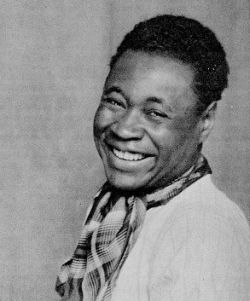
Jean Toomer- A Mixed-Race New Negro

Known as the Harlem Renaissance, or New Negro Movement, the early to mid 1900s coincided with a previously unprecedented amount of creativity in the African American literary community. These writers all wanted to lift up and portray their heritage- either African American or Afro-Caribbean, and use their works to expand the horizons of African American expression. The Harlem Renaissance was a cultural movement as much as an artistic one; it drew aspiring artists and authors to New York. Famous among these were Alain Locke, Marcus Garvey, W.E.B. Du Bois, Langston Hughes, Zora Neale Hurston, Claude McKay and Jean Toomer; all of whom had a hand in crafting the movement. These authors and movement leaders all helped to overthrow the image of the Old Negro as an inferior who did not control production or expression to a New Negro, “self-assertive, racially conscious, articulate, and, for the most part, in charge of what they produced” (Harlem Literature). This renovation of thought was encouraged by literature such as Alain Locke’s The New Negro, published in 1925.


As the movement gained power and prestige, young authors were able to publish a good amount of work while exploring and creating new literary forms. Jean Toomer was one of these. He drew upon a “rich folk tradition [including] oral culture, folktales, black dialect, jazz and blues composition” (Harlem Literature). As a part of the Harlem Renaissance, he was not constrained to one literary or expressive form- he was able to write with his own expression- as he perceived the world.

Jean Toomer’s position in the New Negro movement was unique as a result of his racial ancestry. He was of mixed race, allowing him to flow freely between cultures- he “lived equally amid the two race groups” (Norton 556), eventually drifting closer to his Negro roots for better self expression. As a child, he had alternately attended all-white and all-black schools; and even as he wrote Cane, his most famous work, he had to weigh his heritage. For Toomer, the greatest concern was how to fit in to a society and define himself creatively as a person of mixed race.


His poems, especially the early ones, show this clash of cultures he understood so well. And yet, despite his misfit-ness, he was able to establish himself as an integral part of the New Negro movement. He uses his poems to delve into racial tensions, lynchings, the disappearances of rural life, nature-symbolism, and slavery. He tried to live as all of himself, an American who let all parts of himself exist complementarily. This attitude led to internal conflict that showed through his poems, but also offered him a unique perspective and place in the world of expanding and changing New Negro expression.


Works Cited

Harlem Literature: http://www.jcu.edu/harlem/Literature/Page_1.htm

Norton Anthology of Modern and Contemporary Poetry

Thursday, April 15, 2010

A Caribbean view of the New Negro Movement

Writer Claude McKay lived between cultures, a migrant life shared by many influential modernists. Born in Jamaica in 1890, he moved to the United States in 1912, and therefore both countries claim him, though he also spent eleven years in Europe. In addition, he greatly influenced the literary culture of both the Afro-Caribbean and African American styles, writing verse in both Jamaican English and Standard English.


McKay’s work written in Jamaican English serve as an obvious reminder of his heritage, and also as a backbone and inspiration to the later, and perhaps better crafted Creole verse that emerged in Jamaica. Even his work in the United States, however, shows the great influence of his heritage. McKay’s move to the United States marked a transformation in his writing style; he began to model poets from the Renaissance and Romantic period, and also replaced the colloquial tongue of his homeland with Standard English. This revival of his style, however, did not alter his subject choices; and he brought to the Sonnet “the pain, rage, and longings of an Afro-Caribbean immigrant” (Norton 499). Here, he spans a gap between a strict older form and the intense tension created by a life between cultures. His work deals with his feeling of separation from African culture, alienation, and the relations in race and class society. In his first collection, Songs of Jamaica, especially, this relationship, though acknowledged to be problematic, took on an overarching positive light; that “interracial understanding and love were possible”, and that the peasant Jamaicans could learn from their white neighbors (Hansell 132).

In addition, McKay is considered “one of the first [Renaissance style writers] to express the spirit of the New Negro” (Cooper 297); he was already receiving recognition as a fresh voice in African American literature before the Negro Renaissance truly began. Arriving in the United States from Jamaica in his early twenties, McKay found himself unprepared for the great racial tension and blatant prejudice of America- a mindset foreign to his Caribbean and Songs of Jamaica roots. Slowly, McKay began reestablishing himself as a poet, even as he faced the struggles of race riots and the Great Red Scare. Through all this, however, McKay’s work bloomed and expanded, acknowledging with pieces such as If We Must Die both “tragic hopelessness” and “that in Negroes the spirit of human courage remained fully alive” (Cooper 301). This poem in particular had the greatest impact on the Negro world, with its theme resounding in the hearts of his neighbors and in Ernest Gaines’ novel A Lesson Before Dying. His work continually expressed his interest and concern in the Negro interest, especially the difference between the stereotypes of a naïve, childlike race, and his own worldly, educated view.

McKay was unlike the other members of the New Negro movement by nature of his travel and experiences, and yet, he “represented much that was characteristic of the New Negro” (Cooper 305); including his movement from his rural Jamaican hometown to the urban American north, the importance and value of the Negro in his works, and his breaking free of a limited or isolationist mindset. He remained a proponent of the common Negro, the dignity of the culture, and of tensionless relationship between race and class.

Works Cited
Cooper, Wayne. "Claude McKay and the New Negro of the 1920's." Phylon 25.3 (1964): 297-308. Web. .

Hansell, William H. "Some Themes in the Jamaican Poetry of Claude McKay." Phylon 40.2(1979): 123-39. Web. .

Ramazani, Jahan, Richard Ellmann, and Robert O'Clair. The Norton Anthology of Modern and Contemporary Poetry. New York: W.W. Norton, 2003. Print.

Thursday, April 1, 2010

Janie's Development in Zora Neale Hurston's Their Eyes Were Watching God


Zora Neale Hurston’s novel Their Eyes Were Watching God follows the development of Janie from an naïve adolescent full of dreams to a woman who has seen and walked with the weights of the world. As a young girl, Janie becomes enamored by the idea of love, as seen between the pear tree blossoms and the bees, and she longs for romance- innocently believing it will appear once she is married. This longing for love becomes the driving force behind Janie’s development as a character.


Janie’s grandmother raises her to follow orders and defer to a stronger will, and she tries to create a small, safe world for Janie to live in. Nanny wants Janie to have security, but ends up restricting her dreams; Janie later resents her grandmother for taking the horizon, full of endless possibilities, and pinching “it in to such a little bit of a thing that she could tie about her granddaughter’s neck tight enough to choke her” (89). At sixteen, Janie had “glossy leaves and bursting buds and she wanted to struggle with life but it seemed to elude her” (11). Nanny feared and could not understand Janie’s dreams, and as a result, found her granddaughter stability in a marriage to Logan Killicks.


Before Janie marries Logan, she expects marriage to “compel love like the sun the day” (21), but she soon learns that the life she had imagined for herself is unattainable with Logan. When Janie meets Jody, she believes she has finally found her bee, and she gladly gives up the life she was living to move forward with a man she thought she could love. With Joe Starks, however, life begins to slowly deteriorate. Joe wants Janie to be an ornament he can show off along with his wealth and power, and he bends Janie to his will just as Nanny did. Joe wants Janie to “look on herself as the bell-cow, the other women were the gang” (41), but as a result of his position as mayor, he makes it difficult for Janie to form friendships with the other women. Joe molds Janie into the wife he wants her to be, a soft-spoken shadow to tend the store, and she separates herself into two parts- an outside that she shows Joe and the community, and an inside where she continues to nurture her dreams.


After Joe’s death, Janie begins to enjoy freedom for the first time. When she meets Tea Cake, she does not start a relationship with him because Nanny arranges it, or to escape from an unhappy situation, but because she wants to. Janie blossoms during her relationship with Tea Cake, with him “her soul crawled out from its hiding place” (128). Though their marriage is not perfect, Janie is allowed to be her own person, allowed to talk when she wants to, tell tall tales, or play checkers, and she willingly joins Tea Cake in the fields so they spend less time apart. Together they travel from her home and store in Eatonville, earning money by working the land in the muck. With Tea Cake, Janie enjoys the labor- though Logan Killicks’ attempts to get Janie to work the land with him encouraged her desire to run away. As Tea Cake is struggling with madness, Janie refuses to put him in the hospital because she does not want him to feel abandoned- even though caring for him put her life at risk. After his death, Janie does not want another relationship, she is content to reflect on her love, full with the knowledge that “he could never be dead until she herself had finished feeling and thinking” (193). Janie finds peace because of Tea Cake, but she is strong enough to gather her experiences around her and continue living even after he is gone.