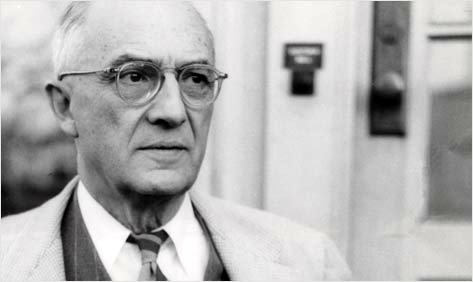
William Carlos Williams helped foster the transition to modern poetry, with a focus on the everyday: on ordinary events, things, people, places, and emotions. Known as a liberator for his imagist poems, Williams’ poetry oftentimes focused on a single object or image so intently that it ceases to be seen as anything less than poetry. This idea can best be portrayed through “The Red Wheelbarrow”, but is also seen in “Danse Russe”, and “The Widow’s Lament in Springtime”.
The Red Wheelbarrow
so much depends
upon
a red wheel
barrow
glazed with rain
water
beside the white
chickens.
upon
a red wheel
barrow
glazed with rain
water
beside the white
chickens.

A wheelbarrow is one of the simplest and most useful elements of a farm, and yet Williams places such exclusive attention on it that the broken sentence is rendered poetic. The deep focus pushes the reader to discover that “the wheelbarrow is not an ordinary object, but is the poem itself” (CCCCD). Williams seems to paint the poem, utilizing line and color to vividly depict the scene: the white of the chickens contrasts the red of the wheelbarrow, which is glazed with water as if a piece of pottery. Just as Williams offers a fresh perspective on a vital tool, rain is used here, as in much of literature, to freshen or make new the image of the wheelbarrow within the poem.
The diction of the poem mirrors its content; as much depends on each word for the function of the poem as on the wheelbarrow for the function of the farm. The stanza breaks and commitment to the image allows a single sentence to become poetry.
Though the wheelbarrow is undoubtedly important, the reader is left to discover why on their own; the wheelbarrow simply sits besides the white chickens, unaware of the stir its rarely applauded significance is causing.
The diction of the poem mirrors its content; as much depends on each word for the function of the poem as on the wheelbarrow for the function of the farm. The stanza breaks and commitment to the image allows a single sentence to become poetry.
Though the wheelbarrow is undoubtedly important, the reader is left to discover why on their own; the wheelbarrow simply sits besides the white chickens, unaware of the stir its rarely applauded significance is causing.
Danse Russe
If I when my wife is sleeping
and the baby and Kathleen
are sleeping
and the sun is a flame-white disc
in silken mists
above shining trees,--
if I in my north room
dance naked, grotesquely
before my mirror
waving my shirt round my head
and singing softly to myself:
“I am lonely, lonely.
I was born to be lonely,
I am best so!”
If I admire my arms, my face,
my shoulders, flanks, buttocks
again the yellow drawn shades,--
Who shall say I am not
the happy genius of my household?
the happy genius of my household?

Every person craves a strange or wild freedom that exists solely, or at least best, when alone and out of sight of societal censure; a werewolf-esque desire that is extrapolated here in a man’s personal expression of happiness. The poem is akin to singing in the shower, a celebration of a moment, a stolen season that exists for one man’s self-discovery and self-admiration.
The diction pushes the meaning of the dance even farther: “If I” begins the poem as a challenge, confident and strong. The sun as a “flame-white disc / in silken mists” emphasizes the idea that this is the picture of a moment, which could end or be concealed at any time. The dance he creates before his mirror is “grotesque”, perhaps a reference to the odd or unnatural positions ballet dancers are trained to execute- the bizarre movements Williams saw while at the Russian ballet could form the basis of his solitary dance. “I am lonely, lonely. […] / I am best so!” could very well be the man’s mantra, as he lives his life by discovering happiness within himself, the “happy genius” and not in outside opinions or events. Here, he is himself in the most exposed and complete form he can be.

The diction pushes the meaning of the dance even farther: “If I” begins the poem as a challenge, confident and strong. The sun as a “flame-white disc / in silken mists” emphasizes the idea that this is the picture of a moment, which could end or be concealed at any time. The dance he creates before his mirror is “grotesque”, perhaps a reference to the odd or unnatural positions ballet dancers are trained to execute- the bizarre movements Williams saw while at the Russian ballet could form the basis of his solitary dance. “I am lonely, lonely. […] / I am best so!” could very well be the man’s mantra, as he lives his life by discovering happiness within himself, the “happy genius” and not in outside opinions or events. Here, he is himself in the most exposed and complete form he can be.
The Widow’s Lament in Springtime
Sorrow is my own yard
where the new grass
flames as it has flamed
often before but not
with the cold fire
that closes round me this year.
Thirtyfive years
I lived with my husband.
The plumtree is white today
with masses of flowers.
Masses of flowers
load the cherry branches
and color some bushes
yellow and some red
but the grief in my heart
is stronger than they
for though they were my joy
formerly, today I notice them
and turned away forgetting.
Today my son told me
that in the meadows,
at the edge of the heavy woods
in the distance, he saw
trees of white flowers.
I feel that I would like
to go there
and fall into those flowers
and sink into the marsh near them.
Sorrow is my own yard
where the new grass
flames as it has flamed
often before but not
with the cold fire
that closes round me this year.
Thirtyfive years
I lived with my husband.
The plumtree is white today
with masses of flowers.
Masses of flowers
load the cherry branches
and color some bushes
yellow and some red
but the grief in my heart
is stronger than they
for though they were my joy
formerly, today I notice them
and turned away forgetting.
Today my son told me
that in the meadows,
at the edge of the heavy woods
in the distance, he saw
trees of white flowers.
I feel that I would like
to go there
and fall into those flowers
and sink into the marsh near them.
Spring generally presents herself as a time of beginnings; of life, and growth, and new buds- and though the plum trees follow their springtime tradition, the Widow only finds misery in flowers that don’t mirror her grief the way the barrenness of winter would. The yellow and red blooms that fill the bushes and cherry trees used to be the joy of the widow and her husband, but now they only remind her of what she has lost. These flowers now “load” their branches as her grief weighs on her heart. The only flowers that do not push old memories onto her are ones she has never seen, trees of white flowers that her son saw at the edge of the meadows and the forest. These flowers offer her an escape, and she craves to take it. Unknown flowers, she feels, would engulf her and take her and allow her to forget long enough to let go and slip unobtrusively into the marsh. Suicide is less of an option surrounded by the bright springtime memories of her own yard.
Williams focuses solely on anguish, and the effect of the emotion on one woman; but her reaction can be generalized and applied to anyone who has suffered loss. Though her lament runs deep and will certainly continue, the reader is offered only one glimpse: as is exists in the moment during the spring.
The images William Carlos Williams creates are vital to his poetry, but beyond that, they are his poetry. His poems take a leap in a new direction, simplifying language in a way that makes the words more poignant- each with its own place and particular significance.

Works Cited
"Explication of The Red Wheelbarrow." Collin County Community College District. Web..
Williams focuses solely on anguish, and the effect of the emotion on one woman; but her reaction can be generalized and applied to anyone who has suffered loss. Though her lament runs deep and will certainly continue, the reader is offered only one glimpse: as is exists in the moment during the spring.
The images William Carlos Williams creates are vital to his poetry, but beyond that, they are his poetry. His poems take a leap in a new direction, simplifying language in a way that makes the words more poignant- each with its own place and particular significance.
Works Cited
"Explication of The Red Wheelbarrow." Collin County Community College District. Web.

No comments:
Post a Comment